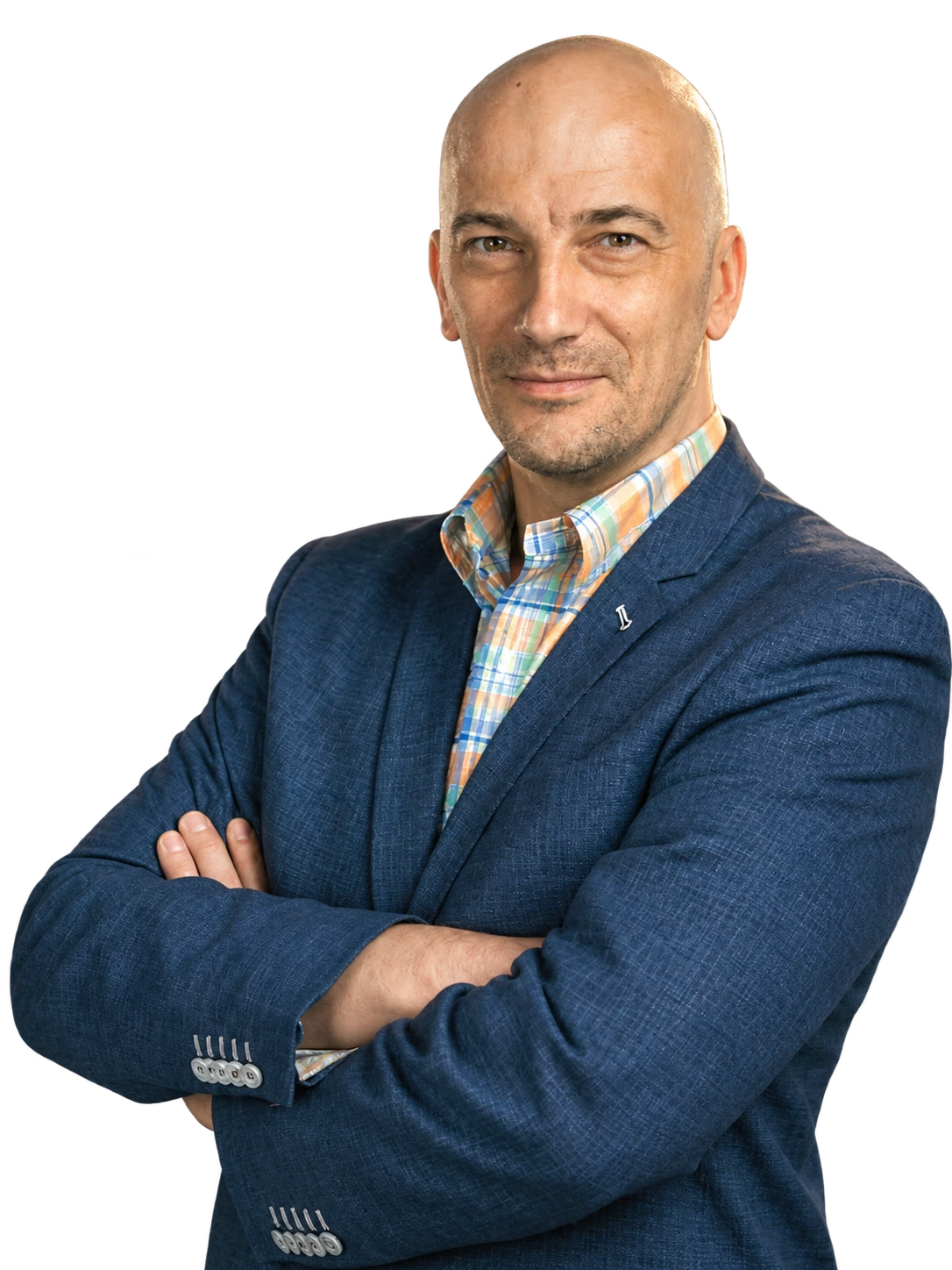
Konstantin Kuchugurin · CIO.

Scaling the business and
the economics of IT

I step into environments where technology has become expensive, closed off and a brake on the business - and in 6–12 months I put numbers on it: what you are losing, what has been freed up, and where to find the money that is not there yet.

First conversation - 45 minutes. By the end I will tell you whether this is my kind of situation.

20B+ cash flow through an online channel built from zero, ~$220M
0.5B+ verified savings and losses prevented, ~$5.5M
200+ people in the teams I have run, budgets of ₽2B+ (~$22M)
15+ years in the C-suite: CIO, CTO, Deputy General Director for IT
Where people start

Choose your role in this conversation

An owner, an investor, a board member and a search consultant ask very different questions about IT. I'll show you exactly what I do for you.

What hurtsIT exists, but there is no one to hold to account

  • Obvious money is left on the table: the client never gets a reminder that support is expiring; a registration is refreshed once a month because the manager forgot. These are conversion points nobody counts.
  • The company sells digital products while its own commercial function runs by hand: partner files by email, re-keying, a day between a partner request and the client appearing in the portal, dozens of people on it. Each owns its piece, and the path from idea to money belongs to no one.
  • There is no one accountable for the task. The departments whose job it is are standing right there.
  • Internal problems get solved around IT - by buying a contractor, or a whole company.
  • AI has been on the agenda for years. It gets deployed by enthusiasts, with no owner and no measurable effect.

What I doI look for losses and new revenue

  • Someone appears who can be held to account: a name, a date, a number. On every task, AI included.
  • I count the losses in money and show what each one is worth: under-selling, conversion, manual work, downtime. The effect is calculated before we start - FTE, speed, errors, cost per operation. Along the way it becomes clear where the money goes and how much support eats.
  • I take the loop from the product to the money: partners, registrations, the customer portal, renewals. The conversation happens where decisions are made, in the language of P&L.
  • Change comes back under management: what to build in-house, what to buy, what to give a partner - decided on economics, timing and risk.
  • AI moves from experiments to a production tool: an owner, a safe data loop, a metric before the start and an effect in money after.

What hurtsYou can't see what you're buying

  • The deck says "modern technology platform". Nobody independent has checked what is actually there.
  • Technical debt and licensing exposure surface after closing, not before.
  • The critical part of the engineering team leaves with the founder, and part of the investment thesis goes with them.
  • IT synergies are in the model but never materialise.

What I doIndependent assessment, then execution

  • IT due diligence: architecture, technical debt, licensing, vendor and key-person dependency, true cost of ownership.
  • Team assessment: who actually holds the system together, who you cannot afford to lose, how to close the gaps. I build the model around the organisation rather than installing an off-the-shelf framework - that model is what a top-10 bank's own HR used to assess 1,200+ specialists. Assessor-side experience as well.
  • A first-100-days plan: what moves EBITDA in year one, quantified in money.
  • Execution inside the portfolio company: I can take it on as interim CIO or advisor and carry it to the result.

What hurtsThe least transparent line item

  • IT is one of the largest and least transparent investment lines, and the board often has no independent expertise on it.
  • Management reports project status. Impact and risk never make it onto the page.
  • Business continuity has been signed off on paper and never tested in practice.
  • Shareholders ask about AI and the company has no coherent answer.

What I doAn independent view, in the board's language

  • Board level: partner to the CEO, the board and shareholders. Prepared and defended three-year IT strategies and annual budgets. At ANO "Russia - Land of Opportunity" I was advisor to the CEO on technology, with a mandate over the function.
  • Independent review: budgets, major contracts and investment cases examined before they reach a vote.
  • Resilience audit: BCP/DRP that has been exercised, not filed. Built continuity for a financial group across four jurisdictions under external constraints and broken vendor chains.
  • Board reporting: money, risk, timing. No jargon and no defending anyone's position.
  • Committee work on strategy, risk and remuneration where technology is involved.

What hurtsThey will learn on your company

  • They need someone who has already run the transformation. Learning on their company is not on offer.
  • Candidates are strong on technology and weak in the room with a CEO and a board.
  • A polished CV with unverifiable numbers and nobody willing to stand behind them.

What I bringA profile that survives checking

  • A permanent in-house role: CIO, CTO, Deputy General Director for IT. Full-time.
  • 15+ years in the C-suite: CIO at Sravni and BCS, CTO at Soglasie and Ingosstrakh (13 years).
  • Scale: IT organisations of 200+, full budget and P&L ownership, direct work with CEOs, shareholders and boards.
  • Cross-border: operations across four jurisdictions; based in Kazakhstan, relocation for a mandate is open for discussion.
  • Referees at CIO, CHRO and VP level - introductions on a reference request.

Who I am

Profile, competencies, and what backs them.

I own both the revenue technology brings in and what it costs. 15+ years in the C-suite: insurance, investments, fintech, e-commerce, the public sector. Plus 15 years running my own business in real estate.

Currently Senior Advisor at ORTALEX and running my own consulting practice.

In parallel I am building two products of my own: an operating system for the CIO, and a second platform I am not disclosing yet.

Business ScalingIT Strategy Digital Transformation P&L ManagementEnterprise Architecture Business ContinuityIT Governance Cybersecurity Governance Vendor & Cost Optimization Organizational Design

Education and certifications

MBA in IT - CROC OK & HSE University, 526 hours · 2016 Internal Talent Marketplace - Tailent Code · 2024 SFIA Accredited Consultant · 2022 Project Management - SKOLKOVO Business School · 2020 Saville Assessment Accreditation · 2019 Facilitation fundamentals - Marina Kurdova School · 2018 SAFe® PO/PM & Leading SAFe® · 2018 ITIL for Executives · 2018

Where I have done this before

Five mandates and my own business. For every one there is a named executive willing to confirm it personally - they are in the references section.

04.2025 – 01.2026

Sravni

Russia's largest fintech marketplace

CIO / Deputy General Director for IT · reporting directly to the CEO

Situation
An oversized IT function, a rising budget and slow recovery from incidents. Support could not keep up with the inbound volume.
What I did
Rebuilt the function into an IT federation: product teams inside business verticals plus shared platform teams. Put service level objectives into OKRs, introduced grading, launched an LLM/RAG loop in support, and appointed a CTO and a CISO from within.
Where the effect came from
Not from a single decision. Vendor management and contract renegotiation, licensing, software replacement, a line-by-line budget review, and removing duplication in the org structure. The freed budget did not stay a saving: it went into product development. Duplication was cut while watching the bus factor: savings that create irreplaceable people are not savings.
under NDAfigures named on the first call
11.2022 – 12.2024

BCS

Financial holding · 120+ IT specialists

Head of IT for the investment and insurance business

Situation
Two businesses sharing one channel: their products cannibalised each other, and the duplication cost the shareholder twice over. On top of that, slow delivery, external constraints and continuity risk where the cost of failure is very high.
What I did
Built and defended a three-year IT strategy tied to the business goals, the budget and the risk: its first objective is growing the share of revenue that comes from IT-built products. Rebuilt the function: one delivery model across both businesses, a portfolio prioritised by P&L impact, and a second-line support desk built again from the ground up. Merged two product streams into one channel, designed and implemented BCP/DRP across four jurisdictions, and stood up the SWIFT perimeter for the Dubai entity from scratch, together with its infrastructure and security engineers. Put AI tooling into engineering and an LLM scenario for market news analysis inside the trading perimeter. What was freed up landed in the business line’s P&L and reached profit.
₽115Mcumulative effect over 2 years, ~$1.3M
−20%time-to-market
99.9%availability of critical systems
2 → 1duplicate on one channel removed
06.2021 – 09.2022

Consulting practice

Raiffeisen Bank · Arrow Capital (TMH) · ANO "Russia - Land of Opportunity"

IT strategy · operating model · capability model

Situation
Three separate briefs: assess the capability of a large IT organisation, cut cost, and accelerate delivery of a national digital platform.
What I did
Raiffeisen Bank: reviewed four industry capability frameworks - none of them worked across functions: you could assess IT with them, but not legal or another function alongside it. Built my own, one model spanning different functions, aligned it with 18 stakeholders and handed it over: the bank's own HR ran the assessment against it. The model is my own work and I am preparing to patent it.
Arrow Capital: joined in-house as interim in a small IT function at the management company and restructured its cost base.
ANO RSV: rebuilt delivery for the digital platform.
90 / 300competencies and skills · Raiffeisen Bank
₽40Msavings potential via ITAM and CMDB, ~$0.4M · Arrow Capital
4M+MAU on the platform · ANO RSV
−15%time-to-market · ANO RSV
09.2019 – 03.2021

Soglasie

Top-10 Russian insurer

Deputy CIO · effectively CTO for B2B, B2C and mobile

Situation
The selling parts of the B2B platform were unavailable a significant share of the time. An ADF-on-Oracle monolith held together by one developer who had become irreplaceable over eight years - a textbook bus factor. Every release was a revenue risk.
What I did
Broke the monolith into microservices, moved delivery to kanban, and introduced APM that exposed the problems in both the code and the database. Restored engineering discipline and monitoring. Separately - took part in building the solution that made countering fraud possible.
99%B2B platform availability
−27%time-to-market
×2development throughput, no headcount growth
under NDAeffect of the anti-fraud loop
06.2006 – 08.2019

Ingosstrakh

Top-5 Russian insurer · 13 years

CTO · Head of IT Training Centre · 13 years

Situation
A traditional insurer at the threshold of digital distribution: effectively no online channel, no public-sector business, and all IT training bought externally.
What I did
Built the engineering behind the online sales channel - the first policy was sold online in 2009. The channel is direct, with no agent commission - on the same premium volume it leaves more with the company. Stood up engineering in Perm and St Petersburg: 64 people, a third cheaper than Moscow. In 2017 mine was the first unit in the company to adopt SAFe: one large team split into product streams. That started the transformation of Ingosstrakh as a whole - one of the first companies in Russia to license the methodology. Opened the B2G channel - MVP in three weeks. Established an internal IT training centre: the market was not releasing people at the rate we needed them, and external courses ran on their own schedule and their own price. 1,300 people trained in eighteen months, ₽60M (~$0.7M) a year saved on external training.
₽20B+B2C channel cash flow, ~$220M
+₽200Ma new channel in its first 6 months, ~$2.2M
3 → 80the unit over 13 years
1,300people trained in 18 months
Spain · 2003 – 2018

My own business

Alicante.ru · property and relocation · offices in Moscow and Spain

Co-founder and managing partner · 15 years

The other side of the table
The five mandates before this one are employed work. Here I was the owner: the brand, demand, people, deals and my own capital in play. More on it below
15 yearson the other side of the table
12 of 15run alongside my job at Ingosstrakh
€1.3Mlargest deal: it began with a budget of 120 thousand

For fifteen years
I wasn't a CIO.
I was an owner.

Spain · 2003 – 2018
Konstantin Kuchugurin

I know what an IT budget looks like when it is your own money.

Co-founder and managing partner of Alicante.ru, with offices in Moscow and in Spain. Formally we sold property. In practice we moved a family and its capital to another country: the property, a mortgage with a Spanish bank, accounts, the foreigner's NIE, schools for the children, a business registered locally. Plus turnkey construction and commercial property.

Deals ran from 50 thousand to millions of euros. One of the larger ones began with "I want a flat, budget 120 thousand" and closed a year and a half later at 1.3 million. Nobody spends that long choosing a property.

Alicante.ru was my own brand - I brought it into the partnership. The Russian side, from demand to people, was entirely mine. In 2008 the market collapsed. I stayed in it for another ten years, deciding every year how much of my own money to put back into the business.

For fifteen years people handed me a decision they could not undo, in a country whose language they did not speak. An owner who opens up their budget, their team and their contracts to a CIO is in exactly the same position.

For twelve of those fifteen years I ran my own business in Spain alongside my job at Ingosstrakh.

References

Contacts shared when you ask for a reference, and with their consent.

Alla PodgornovaIngosstrakh · ex-Vice President
Ruslan SatyukovSoglasie · ex-Head of Retail
Magomed GamzaevSravni · Head of Lending
Albert GalimnurovBCS Capital · Chief Executive Officer
Denis SheybalBCS · Head of Partner Channel
Pavel CharnyORTALEX · Chief Executive Officer
Vladimir TikhomirovIngosstrakh · CIO
Dmitry GuzhelyaANO "Russia - Land of Opportunity"
Vadim KorovinIngosstrakh · ex-CHRO
Alexander KraynikSravni
Elena PopkovaCROC OK

Who I work with

Companies where technology already costs real money, and the next level of scale needs a different management system.

  • Growth has started multiplying complexity. Every new product, market or channel takes more people, more sign-offs and more manual control.
  • IT has stopped scaling with the business. Speed drops, dependencies grow, and every next change costs more than the last one.
  • The function has split into separate silos. Product, engineering, data, infrastructure, security and vendors each optimise their own patch, and the end-to-end result gets lost.
  • The next level of scale needs a system behind it. Accountability, architecture, economics and the way delivery works all have to carry the next stage of growth.
  • IT already shows up in the P&L. An outage, a delayed release, a manual step or a poor integration is counted in money, and IT decisions reach EBITDA.
Revenue ₽5B and up annual, ~$55M
IT function 50 people and up including vendors and outstaff
IT spend ₽300M a year and up payroll included, ~$3.3M
Subject People, processes, systems, risks industries: insurance, investment, fintech, e-commerce, public sector, industrial groups

There is no upper bound: I have run functions of 200+ people and take mandates in organisations with thousands of FTE.

The constraint is not always in IT: often it sits in the business processes themselves, in the project office or in a neighbouring function. The diagnostic shows where it actually is.

Six ways to hire me

The first is a permanent in-house role. The other five are a ladder by depth of involvement: I start with the diagnostic, and its findings show whether the rest is needed.

Executive role, in-house

CIO · CTO · Deputy General Director for IT

  • The whole function: strategy, budget, team, vendors, security
  • Reporting to the chief executive, working with the board and the management team
  • Accountable for both halves: the revenue technology brings in and what it costs
  • The first 100 days run the same way as a mandate: diagnostic, plan, effect in money
Duration
Permanent
Basis
Full-time

IT Diagnostic

CEO · Owner · Investor

  • Landscape map: systems, teams, vendors, contracts
  • Technology economics: where the money is, what is cuttable, what is critical
  • Top-10 risks with likelihood and exposure
  • A 100-day plan with impact quantified in money
Duration
2–4 weeks
Basis
Fixed fee

Advisory

CEO · Board · Sitting CIO

  • Review of budgets, major contracts and investment cases before decisions
  • Second opinion on architecture, vendors and organisational design
  • Mentoring for the CIO/CTO and their leadership team
  • Preparing and defending the IT strategy and budget at board level
Duration
3 months+
Basis
8–20 hrs/month

Fractional CIO

You need a CIO · you cannot justify a full-time one

  • The CIO role with real authority, one to two days a week
  • Accountability for budget, team and vendors
  • A standing rhythm: priorities, leadership meetings, reporting to the business
  • Ongoing - until the company outgrows the arrangement
Duration
3 months+
Basis
1–2 days/week

Interim CIO

Crisis · Transformation · Post-M&A · CIO departure

  • Full mandate over the IT function: people, budget, vendors
  • Operating model rebuild and OPEX reduction
  • Restoring availability and predictable delivery
  • Finding, onboarding and handing over to a permanent successor
Duration
4–12 months
Basis
Full-time

Project engagements

A defined problem with a defined outcome

  • AI across the product development lifecycle (PDLC) and in support
  • Organisational design, grading and team assessment (SFIA)
  • Pre-deal IT due diligence
  • BCP/DRP, including multi-jurisdictional
  • ITSM, SLA/SLO and on-call practice
Duration
1–3 months
Basis
Fixed or T&M

Four steps,
no 200-page reports

The same order in every mandate.

Conversation

I ask, you talk. What is happening, why now, what you have already tried and how it ended. Why the previous person in the role did not work out. And who inside the company considers this role theirs.

Hypotheses and solutions I do not offer at this point: I have not heard you out yet, and guessing would be expensive - a wrong read at the start costs months. By the end I will tell you whether this is my kind of situation.

45 minutes

Diagnostic

I go through the numbers, the contracts, the architecture and the people. I talk to the team and to their business counterparts separately: the two versions diverge, and the gap shows where the problem is.

I start before the formal start date: the first map of hypotheses on the business model, the risks and the org design is built during pre-boarding. The first conversation with the team does not begin from zero.

2–4 weeks · fixed fee

The model

An agreed plan: what changes, in what order, what it is worth in money, who is personally accountable and against which measures.

1–2 weeks

Execution and handover

I run the change hands-on to the result, and leave behind a team and a set of processes that no longer need an outside expert.

3–12 months

What is left behind

The mandate ends. What matters is what still works afterwards.

An approved strategy and budgetA three-year IT strategy and the following year's budget, both defended and signed off by the board.

Clear rolesA grading system and a defined role structure. 95% of the key people stayed through the transformation.

Measures that workSLAs and SLOs written into OKRs, and a portfolio prioritised by P&L impact. That machinery keeps running once I am gone.

The lenses I look through

Eight lenses inside step two: where you are losing money and where the next growth comes from.

Business

What stops the company doubling without IT growing in proportion?

Human capital

Who cannot be lost, and what stops if they resign tomorrow?

Process

How long from a business decision to money, and where does the time go?

Risk

When did you last restore from backup for real?

Systems

What in the landscape rests on one person or one vendor?

AI

What has to change in the product and in delivery to make the next change cheaper?

Economics

What in the landscape creates the next growth, and what serves today scale?

Plan

What in the roadmap still gets done if the budget is cut by a third?

CIO's PlayBook - A Framework for the First Audit
The method, on paper

CIO's PlayBook: a framework for the first audit

The same lenses, drawn out on seven pages: this is the framework I bring into the first conversation with a CEO. The AI lens came later - it is not in the PlayBook yet.

Seven lensesfrom business to the plan 7 pagesvisual, in English
Open the PlayBook

When to work with me,
and when not to

I take the mandate if

  • The decision to change has been made and it will not be reopened every week.
  • You can give a real mandate: unfiltered access to numbers, people and contracts.
  • You want an outcome in money and risk. A strategy document in a nice binder does not count.
  • You are prepared to hear an uncomfortable version of events and engage with it on the merits.
  • The problem is at company or business-unit scale. A single system your architect can handle.

I decline if

  • You need an executor with no authority to decide anything.
  • The deliverable is a strategy for the shelf and a polished presentation of it.
  • Key technology decisions are made outside IT and that is not open for discussion.
  • You need a developer or a solution architect for a specific system - I work a level above that.
  • The real objective is external validation of a decision already taken.

How I work inside the company

  • I do not replace the sitting IT leader. Where there is a CIO or a CTO, I work to strengthen their position. Taking the seat is a different mandate and a different conversation.
  • I put decisions in writing: what was agreed, who owns it, by when. That removes half the arguments before they happen.
  • I do not hand accountability down from above. On one mandate I was asked to "just get rid of the product owner". Instead the roles were mapped by the people in them, over several iterations. It is considerably harder to argue with something you wrote yourself.
  • Nobody knows everything. For a given area I bring in the specialist and learn from them: at Sravni the data perimeter was worked through together with the head of DWH, and some of those calls were his.
  • Disagreements stay inside. What comes out is the decision.
  • I bring bad news myself, and with an option attached. On my teams news you bring is never punished; news you hide always is.

Before you ask

What does it cost?
The diagnostic is a fixed fee, scaled to the size of the organisation. Advisory is a monthly retainer for an agreed number of hours. An interim mandate is priced at the market rate for the C-level role. I give a number after the first conversation, once the scope is clear.
We don't know what's actually wrong. Where do we start?
With the diagnostic. Two to four weeks, fixed fee, and you end up with a landscape map, the technology economics, the top-10 risks and a 100-day plan with quantified impact. From there the decision to continue is made on facts rather than impressions.
Where are you based and which markets do you work in?
Based in Kazakhstan; geography is not a constraint, travel logistics are. The diagnostic requires several visits on site - people and process cannot be assessed over video. Advisory runs hybrid with regular online sessions. An interim mandate assumes presence on the ground; relocation for the duration of the engagement is open for discussion.
How quickly can you start?
A first conversation within days - we need to line up slots. The diagnostic starts within two weeks. An interim mandate depends on current commitments and is agreed case by case.
What about confidentiality?
I sign an NDA before any detailed discussion. On this page I publish only the figures I am free to disclose. The rest, along with internal detail, I discuss once an NDA is in place.
Will you arrive and cut half the IT department?
No. The savings in my mandates came from architecture, procurement, vendors, licensing and automation - not from headcount reduction. At Soglasie development throughput doubled with no increase in headcount. Human capital is the most expensive line in IT.
Is AI real here, or is it hype?
It works where there is volume and repeatability. The LLM/RAG loop in support I rolled out across an organisation: it took over a significant share of tickets and cut their cost several times over. The second job is shadow AI: people already carry work data into personal accounts, and bans do not fix that. I closed it with a sanctioned loop - an owner, data access rules, a metric agreed before the start. On AI across the development lifecycle - requirements, code, testing, release - I run it in my own products and I can see where the cost of a change comes down. I will share the support numbers in a conversation; some are under NDA.
Next step

45 minutes
to find out if there is a problem

Describe the situation in two sentences. I reply within a day and propose a time. No deck, and no selling on the first call.

Or, if you prefer:

Telegram is faster if it is urgent.

By sending this form you agree that the details above are processed solely to answer your enquiry. They are not shared with third parties and are deleted on request.