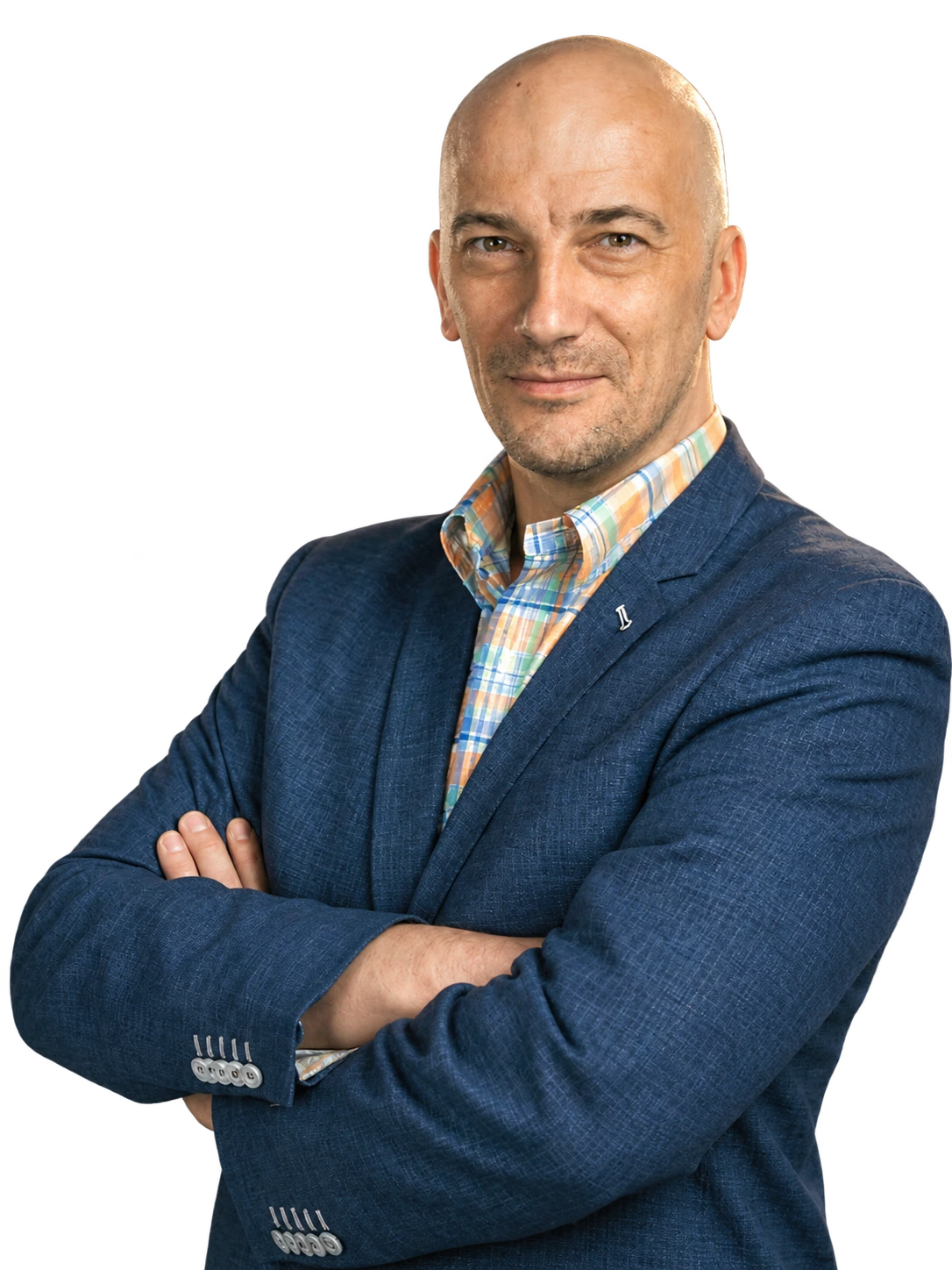
Konstantin Kuchugurin · CIO.

Konstantin Kuchugurin · CIO · CTO

I run the IT function and change it while the business is running

Considering a permanent role · open to relocation · CV (PDF)

The figures above are the ones I am free to disclose; where the impact stays closed, it says "under NDA". How it was calculated, where it started and which part was mine - that I give in conversation.

Who I am

15+ years in IT leadership.
In parallel, for 15 years I was co-founder and managing partner of my own business.

Industries: insurance, investment, fintech, e-commerce, public sector, industrial groups. Most of my roles were in companies supervised by the Bank of Russia.

Education: MBA in IT - HSE University and CROC OK, 2016.

Experience

Currently Senior Advisor at ORTALEX.
Below are the key roles, projects and my own business.

04.2025 – 01.2026

Sravni

Russia's largest fintech marketplace

CIO / Deputy General Director for IT · reporting directly to the CEO

The IT function was outgrowing the way it was run: the budget kept rising, recovery from incidents took hours, and support could not keep up with ticket volume.

Rebuilt the function as an IT federation: product teams embedded in the business verticals, plus shared platform teams. Put LLM-based support into production, developed and appointed a CTO and a CISO from within. 95% of the key people stayed through the transformation.

More

Built SLOs into the OKRs. Launched a review cycle: grades, performance, calibration of ratings across managers and a single incentive system. Built vendor management for the production infrastructure and the data warehouse: transparent communication with suppliers and SLAs. Developed a threat model that the company began to work by. Moved the communication platforms onto Russian products.

The impact did not come from a single decision: vendors, contracts, licences, import substitution, the budget and the org structure. I removed duplication carefully: savings that make people irreplaceable are not savings. The money freed up did not stay as savings - it went into product development.

6×lower cost per support ticket
12×faster response to critical incidents
under NDAimpact on the IT budget
2-5×lower cost with the Russian products
11.2022 – 12.2024

BCS

Financial holding · 120+ IT specialists

Head of IT for the investment and insurance business

An investment and an insurance business across four jurisdictions: a high cost of failure, critical trading systems, slow delivery of change and external constraints. IT had to get faster, cost less and stay resilient at the same time.

Tied IT priorities to P&L impact, rebuilt the change/run split and the delivery model. Built BCP/DRP across four jurisdictions and held the critical systems at 99.9% availability.

More

Set up change, technical-debt and incident management. In parallel, ran import substitution to cut the dependency on foreign software, and put AI to work - from engineering tools to market news analysis. The impact shows in the P&L of the business line.

₽115Mfinancial impact over 2 years, ~$1.3M
−20%time-to-market
99.9%availability of critical systems
2 → 1products on one channel, cannibalisation removed
06.2021 – 09.2022

Project and management roles

Raiffeisen Bank · Arrow Capital (TMH) · ANO RSV

Raiffeisen Bank: built a comprehensive capability assessment model for the bank's Russian IT function of 1,200+ people.

ANO "Russia - Land of Opportunity": came in for a fixed term as advisor to the chief executive on IT, with authority over the whole IT function behind the presidential platform.

Arrow Capital: came in for several months as interim head of IT at the holding's management company.

More

ANO RSV: the CIO and the CTO were within my remit. Built the IT strategy, proposed changes to the organisational design and handed implementation over to the team.

Arrow Capital: ran an IT audit, rebuilt the cost structure and identified ₽40M a year of savings potential.

90 competencies · 300 skillsin the model · Raiffeisen Bank
₽40Msavings potential in IT asset and configuration management, ~$0.4M · Arrow Capital
4M+monthly active users (MAU) · ANO RSV
09.2019 – 03.2021

Soglasie

Top-10 Russian insurer

Deputy Head of the IT Department · accountable for B2B, B2C and mobile products

The B2B platform was available around 80% of the time. The monolith depended on knowledge only a few people had. Every release put sales at risk.

Rebuilt the architecture and delivery: broke the Oracle ADF monolith into orchestrated Spring Boot microservices, moved the teams to kanban and introduced Application Performance Monitoring. Restored engineering discipline and change management. Also took part in building the anti-fraud solution.

99%B2B platform availability
−27%time-to-market
×2development throughput, no headcount growth
under NDAimpact of the anti-fraud system
11.2006 – 08.2019

Ingosstrakh

Top-5 Russian insurer

From head of internet technology to CTO · head of the IT training centre

A classic insurer at the start of digitalisation: instead of an online channel, a corporate brochure site.

Built and scaled the company's digital engineering. The first policy was sold online in 2009. Stood up distributed engineering in Perm and St Petersburg. Launched a digital solution for the B2G channel, with an MVP in three weeks. Created an internal IT training centre.

₽20B+annual B2C channel cash flow, ~$220M
+₽200Ma new line of business in its first 6 months, ~$2.2M
1,300people trained in 18 months
3 → 80people in the unit over 13 years
Spain · 2003 – 2018

My own business

Alicante.ru · property and relocation · offices in Moscow and Spain

Co-founder and managing partner · 15 years

On paper we sold property. In practice we took families and their capital through a move to another country. The brand was mine, and the whole Russian side of the business was on me: demand, sales, the team, six offices across Russia.

In 2008 the market collapsed: I stayed in it for another ten years, deciding every year how much of my own money to put back into the business.

More

Deals ranged from €50K to millions. In the other stories here I answered for the technology result in someone else's business. Here - for my own: the brand, demand, the team, the deals and my own capital at stake.

For fifteen years people made irreversible decisions with me, in a country whose language they did not speak. An owner who hands a CIO the budget, the team and the key contracts is trusting someone else with part of running the business. For twelve of those fifteen years I ran the business alongside my job at Ingosstrakh.

15 yearson the other side of the table
12 of 15years alongside my job at Ingosstrakh
€1.3Mone deal that began as a €75K request

References

Contact details for referees on request and with the person's consent. You also have your own network and background checks - verify it any way you like.

Ilya ZakharovAstra Group · Director, Astra MonitoringWe met in 2020 on an AppDynamics pilot at the insurer Soglasie: I was the technical lead on the vendor side, Konstantin the lead on the client side. The starting point was hard: a landscape built on ageing technology, regular outages, and no monitoring to speak of - problems surfaced only after the fact. On top of that came the first lockdown, and the project had to be run entirely remotely, in one-to-one calls with every participant. In a month to six weeks, inside a single quarter, we went from a standing start to a result presented and signed off - the deadline was mine to answer for, and for a project of that scale in those conditions I consider it outstanding. In twenty years in IT I have learned how rarely you meet someone you can hand the hardest thing to and not check on - Konstantin is one of them.
Andrey BubnovSravni · IT Business PartnerWorking with Konstantin, I saw for myself how rarely you meet a technology leader who is equally at home at the level of strategy and hands-on in the architecture. Behind him are years in fintech, insurance technology and proptech - and the ability to lead a systemic IT transformation from day one: from systems architecture to the processes of cross-functional teams. I would note separately his effect on operational efficiency. He consistently rebuilt the development and operations processes, cutting time-to-market and removing the bottlenecks that were slowing the product teams down. His work on the IT organisational structure was just as strong: he separated the areas of responsibility, put together cross-functional teams that work, and built a structure that scales along with the business. What sets Konstantin apart is that he treats technology as a driver of growth, not only as infrastructure. He connects complex technical decisions to value for the business, keeps communication with stakeholders and the board transparent, and makes considered decisions under pressure. Under his leadership the IT function gained a clear strategic direction and became a real partner to the business. I recommend Konstantin as a strong technology leader who is able not only to articulate a technology vision, but to build the organisation and the processes to deliver it.
Sergey KomarichevSravni · Head of DWHI recommend Konstantin as a highly qualified and dependable professional. First of all for his deep expertise in his field, and for the fact that he constantly keeps new tools, technologies and industry trends in view. Beyond that, Konstantin is an effective and thoughtful manager. He knows how to assemble teams that work, and he approaches every person's professional growth individually, without losing sight of the development of the company as a whole.
More references
Nina VoronovaSravni · RecruitmentKonstantin and I worked together on hiring for the engineering team and on standardising recruitment for technical roles. I would note his involvement in the recruitment process, his openness to a conversation, and his keeping to what was agreed. It was extremely comfortable to work with him: you could feel the expertise in his field and a readiness to get into the detail of a task in order to reach the result faster.
Alexander StyagovBCS · CTOI had the chance to work with Konstantin at BCS, where he was CIO of the "Capital" business line. Konstantin is a strong technology leader with structured thinking and a deep understanding of how technology works towards the goals of the business. He is unfailingly professional, pragmatic in his decisions, and knows how to build effective interaction between teams.
Evgeny MalyginANO "Russia - Land of Opportunity" · Head of ProgrammeWe worked with Konstantin during the period when he was responsible for digitalising the internal processes at RSV. He took a very considered and careful approach to describing the internal processes, how they connect, and what the product teams needed. I recommend him without reservation as a strong professional in his field.
Grigory MelyanIngosstrakh · CPOHaving worked alongside Konstantin at Ingosstrakh, I can say with confidence that Konstantin is an experienced manager with a solid technical background. He has an excellent understanding of how not only the technical systems work, but the business as a whole. I know him as an excellent negotiator who is able to find win-win solutions. Konstantin is definitely someone who works to develop whatever environment he finds himself in.
Pavel CharnyORTALEX · Chief Executive OfficerKonstantin is an experienced professional in modern technology, a responsible and dependable practitioner who puts creating value for the business first. He is interesting to work with and to achieve shared results with. It mattered to me that he is keen on new knowledge and skills and strives to apply them in his work. Besides, you rarely meet an IT professional so deeply engaged with the human side of management. Together we successfully delivered a complex project for the IT division of a fintech company.
Anna TeklinaFormattaI met Konstantin during an assessment we ran while he was working at Ingosstrakh. Even then it was clear that in front of us was not simply a strong technical leader, but a manager ready to work deliberately on his own role and the scale of his influence. After the assessment Konstantin went through several development programmes. What I find especially valuable is that he did not treat the process as a formality or a box to tick. He engaged deeply in analysing his own management patterns, his strengths and his areas for growth. What distinguishes him as a leader is the ability not only to take feedback but to turn it into a management system. He later built his own capability assessment model, adapted to the IT context and to the demands of transformation. This is a rare case where a leader does not simply borrow tools but rethinks them and integrates them into the architecture of his own function. Konstantin consistently widened his focus from managing technology to managing the organisation. His interest in assessing potential, developing teams and organisational design is practical, not declarative. He knows how to connect the development of people to the business result. Working with him is a conversation with a mature leader who understands that the resilience of a company is determined not only by the quality of its IT architecture, but by the quality of its management decisions and the development of its teams. On difficult hires for IT positions I always consult Konstantin, because I trust his judgement and his professional eye a great deal.
Yuri BuluyEPAM · Enterprise ArchitectKonstantin is one of those rare people whose word is followed by the deed. Our work together was always about specifics. Konstantin always states the company's needs clearly and has an excellent picture of the result that has to be reached. With a deep understanding of both the technology side and the business, he is always oriented towards a business result achieved through technology, and he successfully organises vendors and internal resources to get there. It was a good time when we worked together!

How I start in the role

The conversation with the CEO comes before day one. The diagnostic and the 100-day plan take the first 3-6 weeks. After that, change becomes part of running the function.

01

Conversation with the CEO

before day one

I find out what matters most to the CEO or the founder: scale, profit, preparing for a sale or lower risk.

More
  • What is happening and why now
  • What you have already tried and how it ended
  • What stopped working and what has to change
  • Who is responsible for what today, and where decisions get stuck

I do not bring ready answers before day one: guessing is expensive, and a wrong read at the start costs months.

Before I have access to internal data I work through the business model, the risks and the org design, and write down the questions that need checking. So the first conversation with the team does not begin from zero.

02

Diagnostic from the inside

the first 3-6 weeks

I go through the numbers, the contracts, the architecture and the people.

More

I talk to the team and to their business counterparts separately: the two versions diverge, and the gap shows where the problem is.

03

The plan

at the end of the diagnostic

An agreed 100-day plan.

More
  • What changes and in what order
  • Where the company is losing, what gets freed up and where new revenue comes from
  • Who is personally accountable
  • Against which measures
04

Execution and embedding

3–12 months

I run the change hands-on through to the result: in stages and against business metrics.

More

A migration I decided on without checking it first cost three days of downtime. The lesson: check decisions before rolling them out. I build the accountability and the management rhythm into the team.

What I find out in the first weeks

Under each question - what I do with the answer.

01BusinessWhat can the business not launch until IT changes?

I list what is blocked and calculate what the delay costs.

02ProcessHow long from a business decision to money, and where does the time go?

I measure the path from decision to money, then find and remove the causes of delay.

03SystemsWhat rests on one person, one vendor or one system?

I remove single points of failure: a second person, a second vendor, a documented process.

04PeopleWho cannot be lost, and what "stops" if they resign tomorrow?

For every key role I prepare someone who can pick it up.

05Organisational designHas the structure of the function grown with the company, or stayed as it was?

I make it explicit who decides what, with the people in those roles, then put it in writing.

06RiskWhen did you last actually restore a critical system from backup?

I test continuity by real recovery.

07DataCan you trust the numbers decisions are made on, and what does it cost to assemble them?

I bring the metrics to a single logic: one definition, one owner.

08AIWhere does AI produce a measurable impact: in the product - revenue and quality, in delivery - speed and cost?

I launch it into production: an owner, a baseline, result quality, full cost, a stop threshold.

09EconomicsWhere does the IT money go: what protects the business as it is, what makes it more efficient, and what creates the next round of growth?

I split the budget across those three baskets and show it to the board in money.

10PrioritiesWhat stays in the plan if the budget is cut by a third tomorrow?

I rank the portfolio by P&L impact and fix in advance what gets cut first.

The result

For me the result is what has become part of how the company works and no longer depends on my hands-on management.

Money
  • Growth and new revenue

    A B2C channel carrying ₽20B+ of cash flow a year and a new line of business that brought in ₽200M in its first six months.

    More

    Freed-up budget goes into product development.

  • Costs and vendors

    ₽115M financial impact over two years at a financial group.

    More

    No single decision produced it: vendors, contracts, licences, import substitution, the budget and the org structure. Communication platforms moved onto Russian products at 2-5× lower cost.

  • Economics of the function

    The budget is split into resilience, efficiency and growth, and every line of spend is assigned to one of the three.

  • AI in production

    LLM-based support: cost per ticket six times lower. AI also in the development toolchain and in market-news analysis.

    More

    Put into production.

People
  • The team

    95% of the key people stayed through the transformation.

    More

    Grades, performance reviews and calibration as a running cycle, with a single incentive system. A unit grown from 3 to 80 people and an in-house IT academy with 1,300 trained.

  • Successors

    A CTO and a CISO, developed and appointed from within.

Management
  • Strategy and budget

    The IT strategy and the following year's budget, both defended and signed off by the board.

  • Rules that work

    Time to ship changes down 27%.

    More

    Promises on availability and speed (SLAs and SLOs) written into team goals (OKRs), and a portfolio prioritised by P&L impact. Kanban and automated build and release (CI/CD).

  • Management rhythm

    Board reporting and priorities that are not rebuilt from scratch every quarter.

Reliability
  • Availability

    99.9% availability of critical systems across four jurisdictions.

    More

    An insurer's B2B platform went from around 80% to 99% after the monolith was broken into microservices.

  • Incidents and continuity

    12× faster response to critical incidents.

    More

    BCP/DRP across four jurisdictions: the group kept running as external constraints came in and supply chains broke.

  • Security and IT in one flow

    The working agreement rests on one question: what can we do for each other, and how.

    More

    Security nearly always runs as a separate track. The aim is for security to stay invisible, let the business grow and keep the company's external and internal perimeters protected.

Contact

Tell me what the role is and what the company needs. I reply within a day and propose a time.